

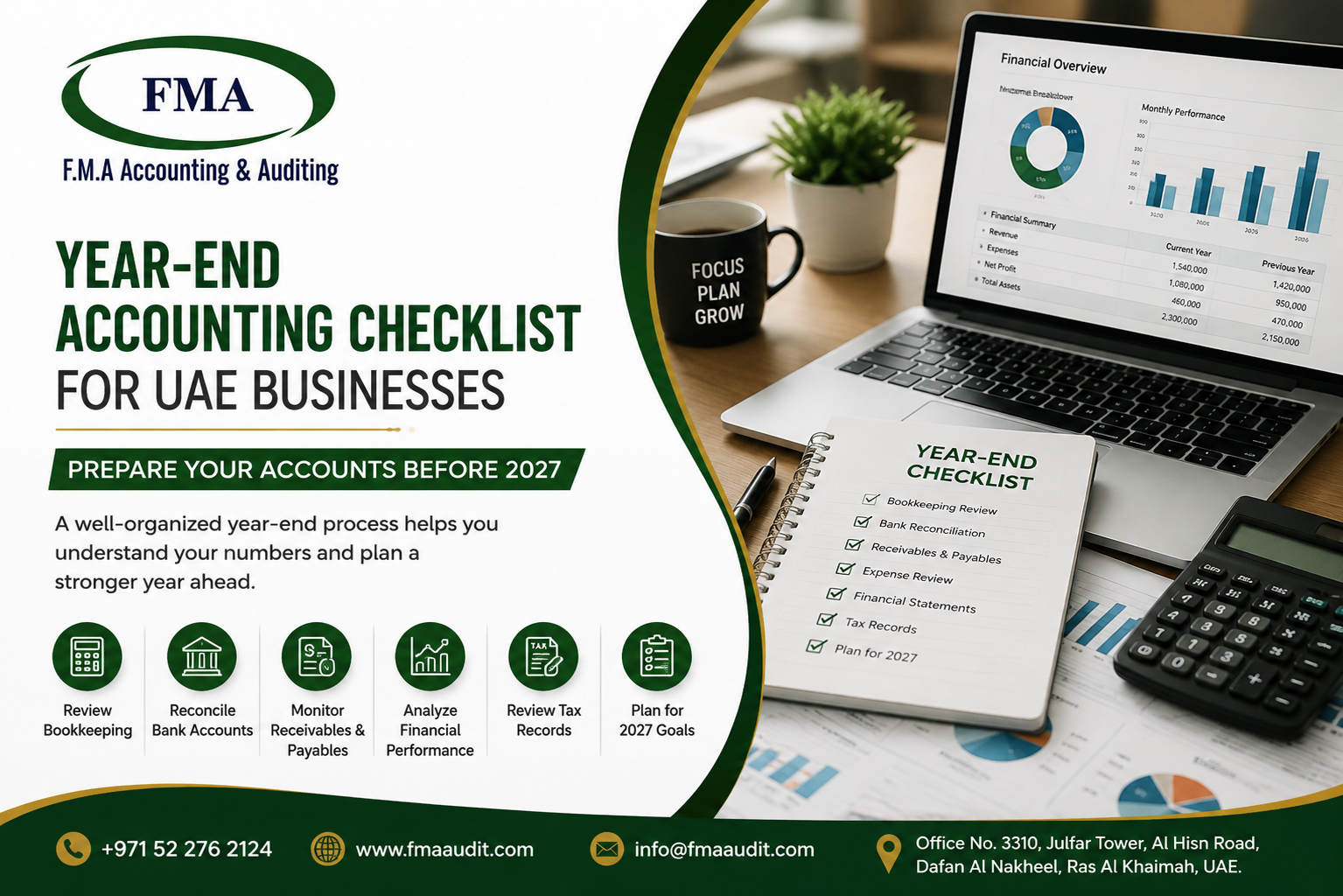
Year End Accounting Checklist for UAE Businesses: Prepare Your Accounts Before 2027
As 2026 approaches its close, UAE business owners have an important opportunity to review their financial performance, organize accounting records, and prepare their businesses for the year ahead.
For many companies, year-end accounting is more than a routine financial task. It helps business owners understand profitability, identify financial challenges, maintain organized records, and prepare for financial reporting and audit requirements where applicable.
Whether you operate a small business, startup, trading company, or established organization in Ras Al Khaimah, proper year-end accounting can help you begin 2027 with greater financial clarity.
At FMA Accounting & Auditing, we support businesses with professional accounting, bookkeeping, auditing, and financial advisory services to help them maintain organized financial records.
Here is a practical year-end accounting checklist every UAE business owner should consider.
1. Review Your Bookkeeping Records
The first step in year-end accounting is ensuring that your bookkeeping records are complete and accurate.
Review all financial transactions recorded during the year, including sales, purchases, operating expenses, and other business activities.
Check whether any transactions are missing, incorrectly recorded, or duplicated.
Proper bookkeeping helps businesses maintain reliable financial information and makes the year-end closing process more efficient.
If your business has accumulated unprocessed transactions throughout the year, consider arranging a bookkeeping review before closing your accounts.
2. Reconcile Your Bank Accounts
Bank reconciliation is an important part of maintaining accurate financial records.
Compare your accounting records with your bank statements to identify differences.
During reconciliation, check for:
- Unrecorded bank charges
- Outstanding payments
- Customer receipts not recorded in the books
- Duplicate transactions
- Incorrect transaction entries
Regular bank reconciliation helps business owners understand their actual financial position and identify discrepancies early.
3. Review Accounts Receivable and Payable
Outstanding customer payments can affect your business’s cash flow.
Prepare a list of customers who have not paid their invoices and review how long each payment has been outstanding.
Contact customers where necessary and establish a clear follow-up process.
At the same time, review your accounts payable to identify outstanding supplier invoices and upcoming payment obligations.
A clear understanding of receivables and payables helps businesses manage working capital more effectively.
4. Check Your Business Expenses
Review the expenses recorded throughout the year and confirm that they are supported by appropriate documentation.
Check whether business expenses have been correctly categorized and whether any personal expenses have been recorded in the company’s accounts.
Maintaining proper expense records helps businesses understand their operating costs and identify opportunities to improve financial efficiency.
It is also important to retain supporting invoices, receipts, contracts, and other relevant documents.
5. Review Your Profit and Loss Statement
Your profit and loss statement provides an overview of your business’s financial performance.
Before closing the year, review your revenue, direct costs, operating expenses, and profitability.
Ask yourself:
- Has revenue increased or decreased compared with expectations?
- Which expenses have increased significantly?
- Are your products or services generating sufficient profit?
- Are there opportunities to improve operating efficiency?
Understanding these figures can help business owners make more informed decisions for the coming year.
6. Prepare for Your Financial Reporting and Audit Requirements
Businesses should review their applicable financial reporting and audit requirements before the year-end closing process.
Depending on the company’s legal structure, licensing authority, contractual obligations, and applicable regulations, an audit may be required.
Companies operating in UAE free zones should also review the requirements applicable to their specific free zone and business activities.
Preparing early can help reduce delays and make it easier to provide the necessary accounting records and supporting documents.
A professional accounting or auditing firm can assist businesses in reviewing their records and preparing for the financial reporting process.
7. Review VAT and Corporate Tax Records
UAE businesses should ensure that their tax-related accounting records are organized and properly maintained.
Review relevant sales and purchase records, tax invoices, expense documentation, and accounting information used for tax reporting.
Businesses should also check whether their accounting records are consistent with their submitted tax returns and identify any discrepancies that may require professional review.
Tax obligations and filing requirements depend on the company’s circumstances and applicable UAE regulations. Businesses should seek professional advice where clarification is needed.
8. Plan Your Financial Goals for 2027
Year-end accounting is also an opportunity to plan for the future.
Once your financial records have been reviewed, use the information to prepare a financial plan for 2027.
Consider setting goals for:
- Revenue growth
- Expense management
- Cash flow improvement
- Business expansion
- Investment planning
- Working capital management
Accurate financial information can help business owners develop realistic budgets and make better strategic decisions.
Why Professional Accounting Support Matters
Managing year-end accounts can become challenging when a business has multiple transactions, outstanding invoices, complex financial records, or limited internal accounting resources.
Professional accounting support can help businesses organize their books, review financial information, prepare reports, and identify accounting issues that need attention.
For businesses in Ras Al Khaimah, working with an experienced accounting firm can also provide convenient access to financial reporting, bookkeeping, auditing, and accounting advisory services.
Get Your Business Ready for 2027 with FMA Accounting & Auditing
A well-organized year-end accounting process helps businesses understand their financial position and prepare for the next stage of growth.
At FMA Accounting & Auditing, we provide professional accounting and auditing support for businesses in Ras Al Khaimah and across the UAE.
Our services include:
- Accounting and bookkeeping
- Financial reporting
- Auditing services
- VAT services
- Corporate tax support
- Business advisory services
Whether you need assistance reviewing your accounts or preparing your business for year-end financial reporting, our team is ready to help.
Contact FMA Accounting & Auditing today to discuss your accounting requirements.
FMA Accounting & Auditing
Office No. 3310, Julfar Tower, Al Hisn Road, Dafan Al Nakheel, Ras Al Khaimah, UAE
Phone: +971 52 276 2124
Website: https://www.fmaaudit.com
Email: info@fmaaudit.com
Start 2027 with organized accounts, clearer financial information, and greater confidence in your business decisions.