

Keep Your Business Audit-Ready: A Simple Guide for UAE Businesses
Running a business is busy enough without scrambling for documents when an audit is due. But being audit-ready doesn’t have to mean preparing everything at the last minute.
For businesses in the UAE, keeping your financial records, supporting documents, and internal controls organized throughout the year can make the audit process much easier — and help you understand your business better.
What Does “Audit-Ready” Mean?
Being audit-ready simply means having your financial information properly recorded, supported, and organized so that an auditor can review it efficiently.
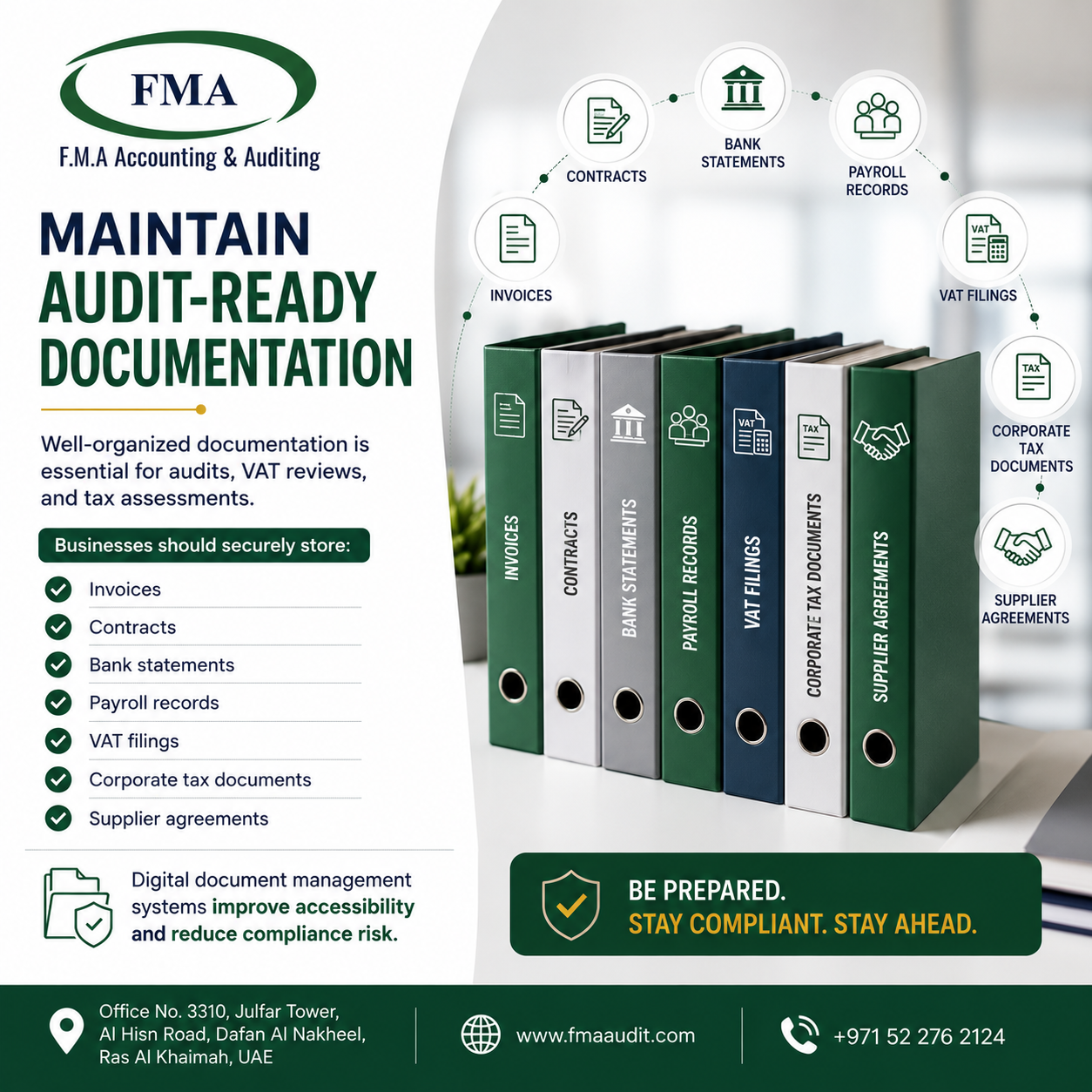
This includes your accounting records, invoices, bank statements, contracts, payroll records, VAT documents, corporate tax information, and other relevant financial documents.
A well-prepared business can respond to audit requests quickly instead of spending weeks searching for missing information.
Why Should Your Business Stay Audit-Ready?
An audit is more than just a compliance exercise. A properly conducted audit can help identify financial risks, weaknesses in internal controls, unusual transactions, and areas where your business processes can be improved.
For UAE businesses, staying prepared can also help with:
- Meeting applicable regulatory and reporting requirements
- Maintaining accurate financial records
- Supporting VAT and Corporate Tax compliance
- Identifying errors or potential financial risks early
- Improving internal controls
- Reducing last-minute stress during an audit
- Building confidence among business owners, investors, banks, and stakeholders
7 Simple Ways to Keep Your Business Audit-Ready
- Keep Your Accounting Records Updated
Don’t wait until year-end to organize your accounts. Record income, expenses, purchases, sales, and other transactions regularly.
Up-to-date bookkeeping gives you a clearer picture of your company’s financial position and makes it easier for auditors to verify transactions.
- Organize Your Supporting Documents
Every important transaction should have appropriate supporting documentation.
Keep invoices, receipts, bank statements, contracts, payment records, payroll documents, and other relevant documents properly organized.
Digital document management can make this process much easier.
- Reconcile Your Bank Accounts Regularly
Bank reconciliation is one of the simplest ways to identify errors early.
Regular reconciliation can help uncover missing transactions, duplicate entries, incorrect payments, or unexplained differences before they become bigger problems.
- Review VAT and Corporate Tax Records
Tax-related records should be maintained carefully and consistently.
Make sure your VAT records, tax invoices, returns, calculations, and supporting documentation are properly maintained. Similarly, businesses subject to UAE Corporate Tax should keep relevant tax records and financial information organized.
- Strengthen Internal Controls
Good internal controls help protect your business from errors, fraud, and financial mismanagement.
Consider having clear procedures for:
- Approving expenses
- Handling cash and payments
- Managing company assets
- Authorizing purchases
- Recording revenue
- Accessing financial systems
Even small businesses can benefit from simple and practical internal controls.
- Review Your Financial Statements
Don’t look at your financial statements only when the auditor asks for them.
Regularly reviewing your Balance Sheet, Profit & Loss Statement, and Cash Flow Statement can help you spot unusual movements and understand how your business is performing.
If something doesn’t look right, investigate it early.
- Work With Your Auditor Throughout the Year
Your relationship with your auditor doesn’t have to begin only when the audit deadline approaches.
Regular communication with an experienced audit professional can help you identify documentation gaps, accounting issues, and control weaknesses before they create problems.
A Quick Audit-Readiness Checklist
Before your next audit, ask yourself:
☑ Are all accounting records up to date?
☑ Have bank accounts been reconciled?
☑ Are invoices and receipts properly organized?
☑ Are contracts and important agreements available?
☑ Are VAT records complete?
☑ Are Corporate Tax records properly maintained?
☑ Have unusual transactions been reviewed?
☑ Are internal controls working effectively?
☑ Are financial statements regularly reviewed?
☑ Can your team quickly provide documents requested by the auditor?
If you answered “yes” to most of these questions, you’re already on the right track.
Don’t Wait Until Audit Season
The best time to prepare for an audit is before the audit begins.
For businesses in Ras Al Khaimah, Dubai, Sharjah, and across the UAE, maintaining accurate accounts and organized documentation throughout the year can make the audit process smoother and more efficient.
At FMA Accounting & Auditing, we help businesses with professional accounting, bookkeeping, statutory audit, internal audit, VAT, Corporate Tax, and business advisory services.
Whether you’re a growing SME or an established UAE company, staying audit-ready can give you greater financial clarity and peace of mind.
Need Help Getting Your Business Audit-Ready?
FMA Accounting & Auditing
Office No. 3310, Julfar Tower, Al Hisn Road,
Dafan Al Nakheel, Ras Al Khaimah, UAE
📞 +971 52 276 2124
🌐 www.fmaaudit.com
📧 info@fmaaudit.com